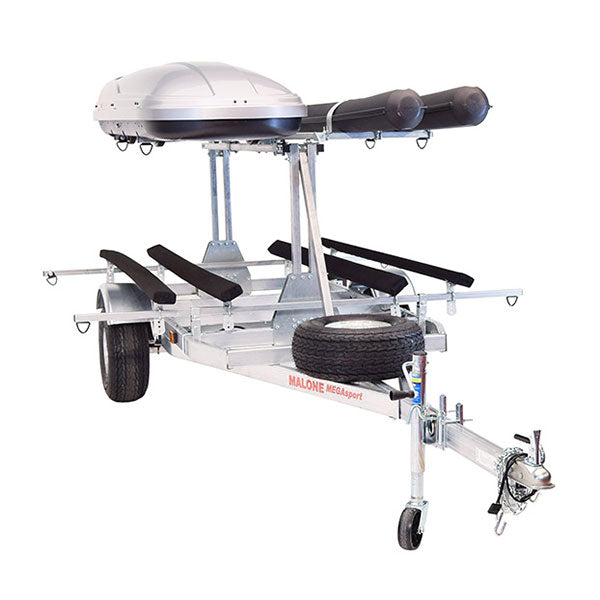
The MPG550-LBB is a MegaSport™ LowBed™ Trailer fully outfitted with a 2nd Tier Kit, MPG910 Profile™ Roof Box, 2 sets of Rod Tubes, a Spare Tire with Locking Attachment and either two Large Kayak Bunks or two SaddleUp™ Pro Kayak Carriers. This set-up represents our top "Pro Level" offering for transport of multiple large fishing kayaks with nearly any hull configuration
With the 86” load bars positioned 25” from the ground, loading and unloading heavy fishing kayaks is a safe and simple process. To avoid portage, these galvanized marine grade trailers can be backed down a boat ramp in order to launch the kayaks directly into the water. Features include submersible LED lighting, 10” pontoon all-terrain tires, wiring harness with two accessory outputs and a Class II (2”) hitch receiver.
The 2nd Tier has a 150 lb. load rating and provides transport for the Cargo Box and Rod Tubes. The 58” upper load bars provide an “easy to reach” height of 56” which allows access without climbing onto the trailer frame.
The trailer has a load rating of 1000 lbs. and is DOT and Transport Canada certified. Fully illustrated instructions allow assembly in approximately four to five hours with standard tools.
What is included in this package?
Both versions include the MegaSport LowBed trailer with its custom second tier kit, two 86-inch lower load bars and two 58-inch upper bars, two high-speed wheels on 21-inch tires, a full-size spare tire with lock, a Profile roof box, two rod storage tubes, the reinforced tongue with kick stand and lift handle, DOT-approved LED lighting and axle bearings, a pre-tested electrical system, pre-fitted chassis components, two sets of kayak carriers, and the manual with registration paperwork.
Only the carrier style differs between the two versions: two sets of large kayak bunks, or two sets of SaddleUp Pro carriers.
What hitch hardware does it need?
The trailer coupler requires a 2-inch-diameter hitch ball, and the top of that ball should sit 16 inches from the ground so the trailer tows level. That is the trailer's side of the connection. Lighting is a DOT and Transport Canada approved plug-and-play LED system, and the wiring harness carries two accessory outputs.
Your vehicle needs a hitch with a receiver, a ball mount that fits that receiver, and a 2-inch ball fitted to the ball mount. A receiver does not take a ball directly, and receiver size is a separate matter from ball diameter — a 2-inch ball does not mean you need a 2-inch receiver. Hitch, receiver, ball mount, ball and tow vehicle must each be rated for the loaded trailer, and the lowest rating in that chain governs.
Fully loaded, this is close to a 1,000-pound tow with a raised center of gravity.
What maintenance does it need?
Before each trip: lights, coupler and pin, crossed safety chains, lug nuts, condition of all three tires including the spare, box latches, and every strap on both decks. Service the wheel bearings on the schedule in your documentation, and stay on top of it if you launch from ramps. Rinse the frame, wheels, tier, carriers and accessory mounts with fresh water after salt water or road salt.
Inflate to the Malone-recommended cold pressure for this trailer, 35 to 40 PSI, checked before towing while the tires are cold, and follow the trailer documentation and current manufacturer specification. A sidewall maximum is not the recommended operating pressure — read the sidewall for tire size, load range and maximum limits, not for the figure to inflate to.