
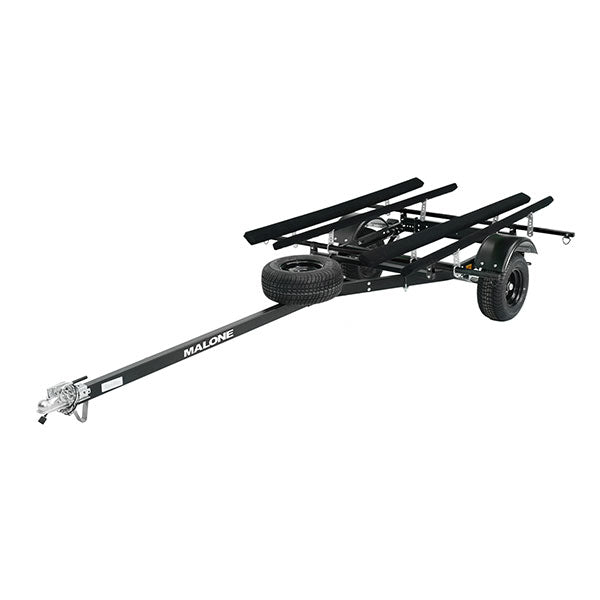
Malone MicroSport™ Off-Road LowBed™ 2 Kayak Trailer Package
✓#1 Authorized Malone Dealer
✓ Lowest Price Guaranteed
✓ FREE & FAST Shipping: In Stock & Ready to Ship
✓ Questions? Call a Malone Expert: 1-844-987-5777
✓#1 Authorized Malone Dealer
✓ Lowest Price Guaranteed
✓ FREE & FAST Shipping: In Stock & Ready to Ship
✓ Questions? Call a Malone Expert: 1-844-987-5777
The MicroSport™ Off-Road Trailer is full submersible and offers a unique black powder coat over a pre-galvanzied steelframe creating one of the most rust-preventive coatings in the industry. This trailer is identical to the base MicroSport Off-Road trailer except with lowered crossbars for ease of loading. Each kit is comprised of a sturdy steel tongue, a “plug-&-play” LED submersible lighting system that meets DOT standards, 78" steel load bars, and large oversized pontoon tires. With the use of common tools, assembly can be accomplished in around three to four hours. Backed by a Five-Year Limited Warranty and proudly crafted in the United States.
Bunks
Saddle Up pro
Both versions include the MicroSport Off-Road LowBed trailer, a full-size spare tire with lockable attachment, two sets of kayak carriers in the style you select with mounting hardware and straps, and the instruction manual with registration paperwork. Assembly is required and it ships as a multi-boxed item.
The carton count differs between the two carrier styles. Complete package weight is around 217 pounds before boats.
The 78-inch load bars sit 22 inches from the ground on this trailer, against 30 inches on the standard Off-Road. A heavy fishing kayak can be slid aboard rather than lifted, which matters most when you are loading alone or at the end of a long day.
The trailer is fully submersible and can be backed down a ramp so boats launch directly into the water. Ramp surfaces vary and every submersion asks more of the bearings, so rinse afterwards and keep to the service schedule in your documentation.
Padded bunks support a hull along a long run of its length. That is what large, heavy, fully rigged fishing kayaks need, and what flat and pontoon-style bottoms need in particular.
SaddleUp Pro carriers cradle the boat at set points, conform well to center-keel and irregular bottoms, load quickly and take up less bar width.
Hull shape decides it rather than boat length. Send us the make and model of both kayaks and we will confirm which version supports them properly.
The trailer's. Its 800-pound total is the controlling limit for the complete load — both kayaks, both carrier sets, the spare tire, straps and any gear counted together.
A carrier's own rating describes what that carrier can support, not what the chassis is approved to carry, and carrier ratings never add together. A bunk kit rated for 500 pounds per boat does not permit two 500-pound boats on an 800-pound trailer. Always work down from the trailer's total.
Boats up to 20 feet, on 78-inch bars with an adjustable 44-to-63-inch spread. Beyond length, beam and hull profile decide whether two boats sit alongside each other comfortably and whether your chosen carrier supports them properly.
Two wide sit-on-top fishing kayaks are the usual pinch point. Measure the beam of both, weigh them loaded as you actually travel, allow clearance between hulls and hardware, and contact our team if it looks close.
The trailer coupler requires a 2-inch-diameter hitch ball, and the top of that ball should sit 18 inches from the ground so the trailer tows level. That is the trailer's side of the connection. Lighting is a DOT-approved plug-and-play submersible LED kit, so confirm your vehicle's connector matches.
Your vehicle needs a hitch with a receiver, a ball mount that fits that receiver, and a 2-inch ball fitted to the ball mount. A receiver does not take a ball directly, and receiver size is a separate matter from ball diameter — a 2-inch ball does not mean you need a 2-inch receiver. Hitch, receiver, ball mount, ball and tow vehicle must each be rated for the loaded trailer, and the lowest rating in that chain governs.
A LowBed sits closer to the ground than the standard Off-Road — watch ruts and steep approach angles.
Yes — roughly three to four hours with common tools for the trailer, then the carriers and spare tire. Bunks take longer than saddles because they adjust for width, height and angle, and they are best set with the boat present so you can match the hull.
Carton count varies between the two versions and shipping method can vary too. Inspect the shipment against the supplied documentation before starting, keep the paperwork envelope, and report anything missing or damaged promptly at sales@ecofishingshop.com.
Before each trip: lights, coupler and pin, crossed safety chains, lug nuts, condition of all three tires including the spare, and every strap and carrier fastener. Service the wheel bearings on the schedule in your documentation, and treat regular ramp launching as a reason to stay ahead of it. Rinse frame, wheels, carriers and hardware after salt water, mud or road salt, and keep bunk carpet clear of grit.
Inflate to the Malone-recommended cold pressure for this trailer, 35 to 40 PSI, checked before towing while the tires are cold, and follow the trailer documentation and current manufacturer specification. A sidewall maximum is not the recommended operating pressure — read the sidewall for tire size, load range and maximum limits, not for the figure to inflate to.
A five-year limited warranty covers defects in materials and workmanship for the original retail purchaser, subject to the written terms and exclusions. Normal wear, corrosion, accidents, misuse, overloading and problems traced to assembly errors are excluded, and no claim outcome can be promised in advance. Register with Malone within 30 days of purchase and keep your original receipt.
That is separate from titling or plating the trailer for road use, which varies by state and province. Check with your state motor vehicle agency.