1-844-987-5777 Mon-Fri: 8am-4pm CST
1-844-987-5777 sales@ecofishingshop.com Mon-Fri: 8am-4pm CST
Kayaking on the ocean or big lakes introduces variables that not all fishing kayaks are built for. If you are a kayak angler looking to get offshore or on large lakes with open water, safety is the first priority. So, what are the best kayaks for big water?
Before we get into fishing kayaks for offshore fishing, it's more important to talk about the attributes you should look for in a kayak and some of the non-negotiable safety tips for kayaking offshore. After we talk to basics, we'll share some of our choices for the best fishing kayaks for ocean fishing. Attributes you should consider:
Primary & Secondary Stability Defined
Primary Stability
This refers to how stable a kayak feels when you're sitting flat on calm water. A kayak with good primary stability will feel steady and balanced, making it easier to get in and out of and to paddle in a straight line. Think of it as the initial stability of the kayak when you're just sitting still.
Secondary Stability
Secondary stability comes into play when the kayak is tilted or leaned to one side. It's about how stable the kayak feels when it's leaned over, such as when you're making a turn or dealing with choppy water. A kayak with good secondary stability will resist tipping over even when it's tilted at a significant angle.
In a fishing kayak, both primary and secondary stability are crucial. Good primary stability provides a stable platform for activities like casting, reeling in fish, or standing up to get a better view. Meanwhile, good secondary stability ensures that the kayak remains stable and won't suddenly tip over if you lean to the side while fighting a fish or navigating rough waters. Balancing these two types of stability is key to choosing a kayak that suits your fishing needs and preferences.
Two Main Hull Shapes for Fishing Kayaks
V-shape Hull
Like its name, a V-shaped hull comes to a deep V from the sides of the kayak to the hull point. The defining characteristic of V-shape hull kayaks is straight line speed. Due to the V shape, these kayaks ‘knife’ and ‘cut’ their way through the water with minimal drag. When taking on rougher water, this kayak hull shape performs well by knifing its way through choppy water. Paddlers looking to reach higher speeds with less effort and excellent tracking will like kayaks with this hull shape.
What these hulls offer in speed and efficiency they sacrifice in stability in calmer water. If you are new to kayaks, you may find that v-shape kayaks feel ‘tippy’ when you first sit in them. Much like riding a bike, these types of kayaks feel more stable as you gain more speed. If you will be fishing water that is typically calm or has very little chop, a V-shaped hull may not be for you. V-shape kayaks are also more difficult to turn.
Pros:
Cons:
Poontoon-style Hull
As you probably gathered, the pontoon-style hull mimics that of a pontoon boat. Pontoon hulls are sometimes also known as ‘tunnel’ hulls because underneath they have two channels for the water to move through. Pontoon hulls are popular on fishing kayaks because, much like a pontoon boat, they offer incredible stability. Many anglers prefer to stand and cast from their fishing kayak. With a pontoon-style hull and more stability, anglers can stand with more confidence.
To obtain that level of stability, however, pontoon-style hulls sacrifice speed and precise maneuverability. Like a pontoon boat, pontoon-style kayaks take an extra paddle stroke or longer pedal stroke to turn.
Pontoon-style hulls are good all-around fishing kayaks that provide stability in multiple water conditions such as rivers, lakes and open water. They can handle bigger waves, but they sacrifice speed and do not ‘knife’ through rough water as well as a V-shaped hull.

Pros:
Cons:
Kayak Attributes to Consider for Ocean & Big Water Fishing
Kayak Length
Kayak length does not always equal stability. The reason we mention length is primarily for taller anglers. A longer kayak may provide more cockpit space for those of you who have longer legs and torsos.
When kayak length does play a role in stabilty is when taking on waves or wakes. Longer kayaks typically cut through waves and wakes a bit better than shorter kayaks. This is also when kayak hull shape comes back into play. The longer V-shaped kayaks will knife through current and waves far better than pontoon-style kayaks.
Longer kayaks do not always equal more cockpit space either. For example, the cockpit space of an Old Town Sportsman 106 vs. 120 is not that different. The extra length gives more bow & stern storage space. Talk with a dealer to learn if longer versions offer more space for your legs or not.
Kayak Width
Kayak width plays a bigger role in primary stability than kayak length does. When at rest, a wider kayak will feel more spacious and more stable. Wider kayaks are typically easier to stand and fish in than skinnier kayaks. As mentioned above, a narrower kayak with a V-shape hull will feel far more stable when in current or while moving.
A wider kayak will also offer more room to stretch out and more room for gear without the angler feeling as cramped.
Weight Capacity
This is straight-forward. If you are a larger angler, one of the most important attributes to look at is the weight capacity of kayak. One of the biggest reasons a kayak can feel unstable is because the weight capacity has either been exceeded or is being pushed far too close to the max. Exceeding the weight capacity alters the primary and secondary stability of a kayak.
An angler must consider more than what a kayak's max capacity is rated at. There is a general rule of thumb that says you should take what the listed max capacity is and times it by 70% to get your usable capacity. The 70% rule is not a definitive rule, but can help keep you in the desired weight range to maintain your stability and maneuverability. For example, if a kayak's weight capacity is 500lbs, you'd want to try and keep your total weight (angler and gear) in the 350-375lb range.
Considering the 70% "rule," you'll want to keep your own weight as well as your gear weight in mind when searching for the right fishing kayak for you.
Hull Shape
As we discussed above, your hull shape is going to play a huge role in how well you move through water and how safely you are able to navigate through current and rolling waves. When you are looking to kayak on the ocean or large lakes, you will want to focus on longer kayaks that have some sort of v-shaped fishing kayak. Longer kayaks will help get on top of waves as well as cut through waves better. These are essential attributes for kayak fishing offshore.
If you plan to exclusively fish on open water, turn your focus to kayaks with length, a v-shaped bow and fishing kayaks with the capability of adding secondary propulsions.
Two types of propulsion
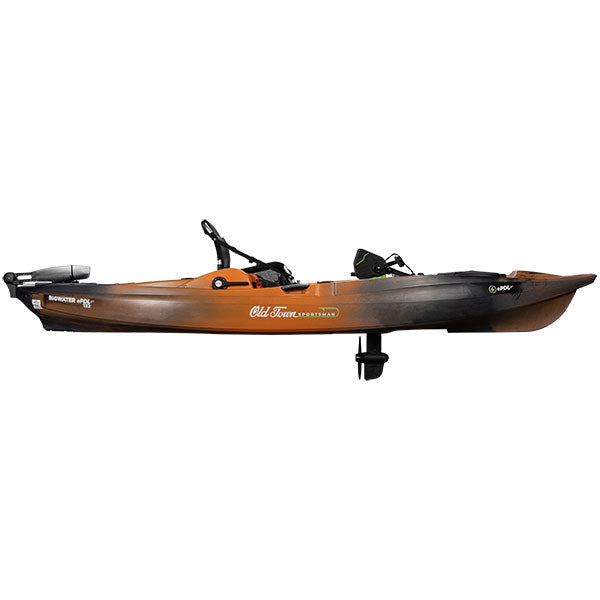
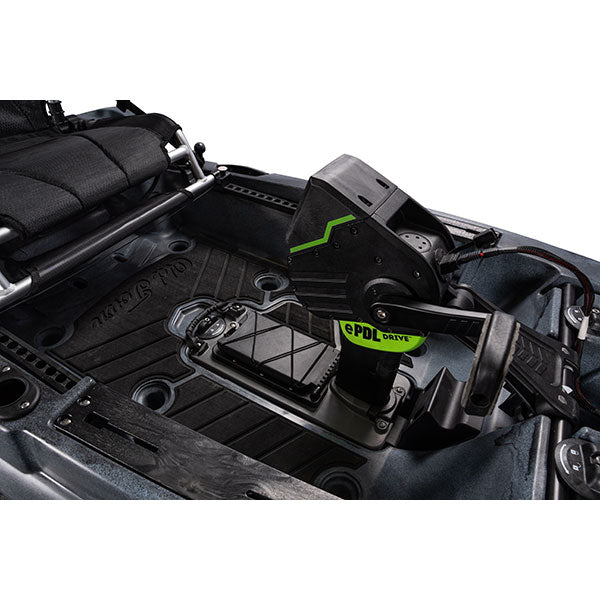
All kayaks should have a paddle. Thinking of your hull shape, a longer kayak with a v-shape is going to track and paddle more efficiently which is essential over long distances. But, when it comes to fishing offshore, we advise our anglers to have two types of propulsion. Look for kayaks that have built-in pedal drives or the capability of adding a motor. Always plan for the worst and prepare yourself with two types of propulsion for any scenario that may arise like a dead battery, fatigues muscles or weather changes.
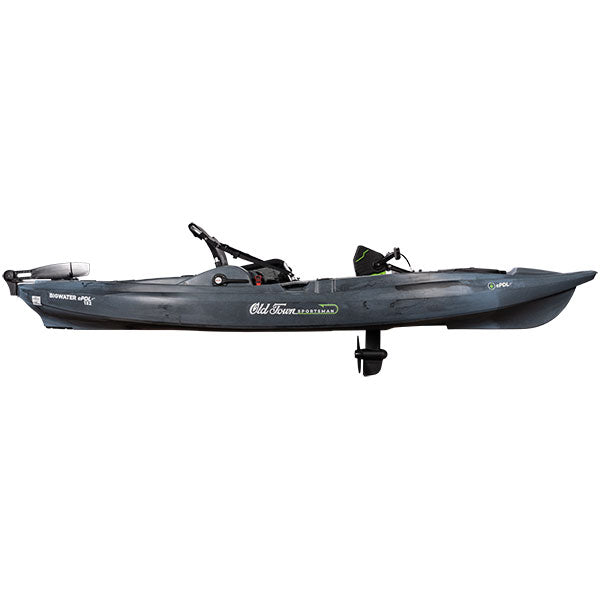
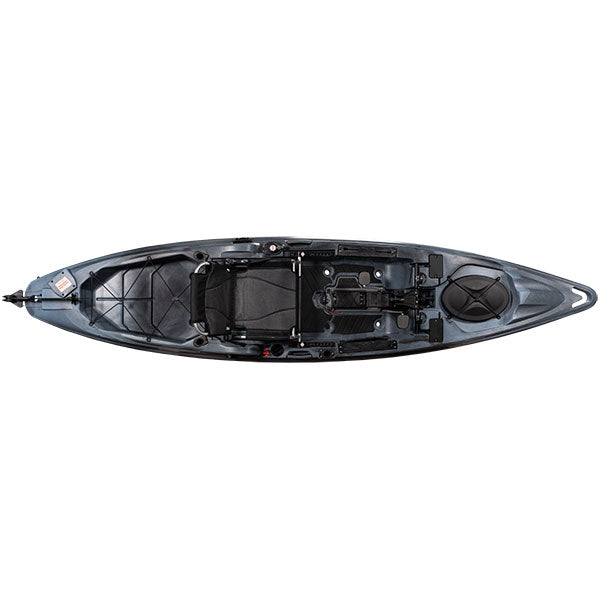
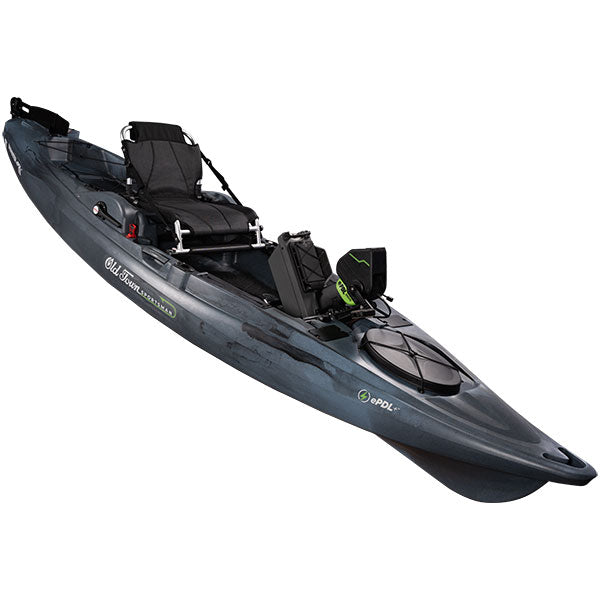
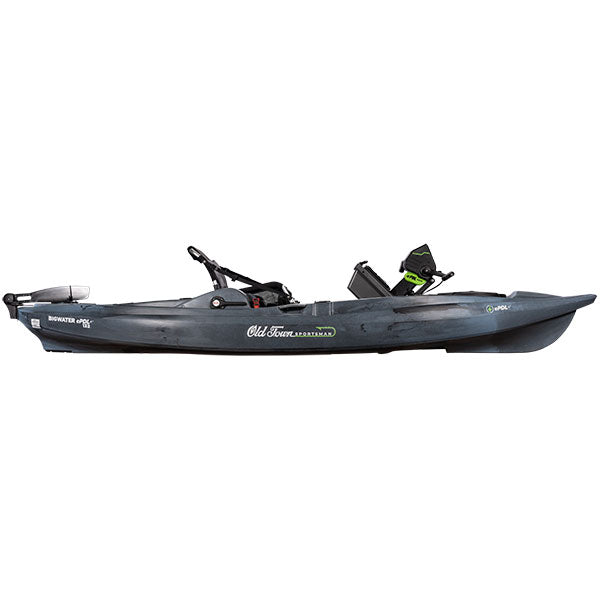
Fishing Kayaks for Big Water & the Ocean
Important Safety Tips for Kayak Fishing on the Ocean
Always WEAR Your PFD
We sound like a broken record in every blog and podcast we do. With such an available variety of Life Jackets available, there is no excuse for not wearing one. By the time you wish you'd worn your PFD it is already too late. Almost all cases of kayak/canoe/paddleboard drownings and fatalities find the victim wasn't wearing a PFD. The need for your lifejacket to be on is only heightened when kayaking on big water where the variables are more dangerous and change quickly.
Share Your Float Plan
This one is pretty straight-forward. Always let someone know your float plan. Let someone know where you are launching from, what time and when you plan to return. Leave your float plan with someone so that if disaster does strike, someone can alert local authorities to know where you were going and when abouts you'd be there. This strategy is true whether you are on floating a river or fishing 5 miles offshore.
Have a Way to Contact Shore
If you are fishing offshore or on a large, open lake, you should have more than one way to contact shore. Cell phone batteries die and service can be unreliable at times. Having a long-range radio/walkie or sattelite phone is an option to guarantee you have a way to contact shore if weather conditions change or you are facing an unforseen emergency. Another option is keeping a flare on board for absolute emergencies. Plan your trips as if something IS going to wrong so that you are prepared.
Dry Bags with Extra Clothes & Safety Gear
You are going to get wet when fishing on the ocean or big lakes. You should plan for weather conditions to change on you quickly and that you should bring along extra gear for when that happens. A dry storage bag can keep things like a flare, radio and any other potential safety gear from getting soaked.
Two types of propulsion
All kayaks should have a paddle. Thinking of your hull shape, a longer kayak with a v-shape is going to track and paddle more efficiently which is essential over long distances. But, when it comes to fishing offshore, we advise our anglers to have two types of propulsion. Look for kayaks that have built-in pedal drives or the capability of adding a motor. Always plan for the worst and prepare yourself with two types of propulsion for any scenario that may arise like a dead battery, fatigues muscles or weather changes.
Food, Water & Sun Protection
Plan for long days on the water that may involve a lot of sunshine. Make sure you have proper clothing, sunblock and most importantly plenty of water. You won't be simply returning to shore or the boat launch when you are 4-5 miles offshore. Getting dehydrated can create a bad situation really quickly so pack enough water for your entire trip. In hot/sunny weather, wear SPF clothing and protect your head & neck.
Secondary Propulsion for Ocean & Big Water Kayaking
Force® Pro Trolling Motor with Built-In GT56UHD-TR Transducer Move fast, move quiet with the Force Pro trolling motor — engineered with a powerful...
View full detailsNewport NK300 HD Electric Kayak Outboard Motor The NK HD Series represents the next generation of Newport’s flagship kayak motors. Built aroun...
View full detailsNewport NK180 HD Electric Kayak Outboard Motor The NK HD Series represents the next generation of Newport’s flagship kayak motors. Built aroun...
View full detailsMinn Kota Terrova Kayak Trolling Motor Effortless, reliable control for your kayak. With Minn Kota's most advanced GPS trolling system, inclu...
View full detailsForce® Kraken Trolling Motor THERE’S A NEW LEGEND TO BEHOLD The Force Kraken trolling motor is engineered with a longer shaft for boats with high...
View full detailsVanhunks Fin Drive System The removable Fin Drive System is straightforward to use, allowing you to reach top speeds in no time and maintain momen...
View full detailsEpropulsion Spirit 1.0 Plus Electric Outboard Motor Spirit 1.0 Plus is a portable 3HP electric outboard made for dinghies, fishing boats, sail...
View full detailsVanhunks Propeller Drive Hands-Free Kayak Fishing with Forward-motion and Reverse. The crank is designed for speed and maneuverability; the Vanhun...
View full detailsFeelfree MotorDrive 48V- Kayak Motor Say hello to the all-new 48V Motordrive! When paired with your Overdrive Pedal System (required), the Mot...
View full detailsPivot Drive Pedal System The NuCanoe PIVOT Drive System is a high performance pedal drive accessory for the F10, Flint, Frontier 12, Pursuit or Un...
View full detailsWilderness Systems Helix PD Experience true innovation in motion with the Helix PDTM Pedal Drive. Featuring a 6:1 gear ratio precision-tuned t...
View full detailsEpropulsion eLite Electric Outboard Motor The ePropulsion eLite 500W electric outboard redefines your on-water experience with innovative featur...
View full details2025 Bixpy K-1 Angler Pro Motor Outboard Kit Bixpy K-1 - Powerful, Portable Marine Propulsion The Bixpy K-1 Angler Pro Outboard Kit™ is Bixpy's pr...
View full detailsNewport NK180 Electric Motor The NK180 brushless kayak motor offers excellent performance and power to any kayak angler looking to increase th...
View full detailsNewport NT300 Electric Motor With the NT300. anglers can tap into freedom: freedom from the gas pump, the boat ramp, and the constant need for mai...
View full detailsTorqeedo Travel Ultralight Adventure Package The Adventure Package takes kayak fishing to the next level. The Travel UL, an 1100W, 3 HP-equiva...
View full details2025 Bixpy K-1 Motor Outboard Kit Bixpy K-1 - Powerful, Portable Marine Propulsion The World’s smallest, most advanced, modular water propulsion s...
View full detailsGarmin Force® Current Kayak Trolling Motor The Force Current trolling motor is engineered for kayak anglers looking for a rugged propulsion s...
View full detailsTorqeedo Travel XP Bigger boat? More challenging conditions? Look to the Power Package! The Travel XP forms the heart of the Power Package, and wi...
View full detailsPower Pole Adapter The Power Pole WillFit™ Adapter allows you to quickly and easily add a Bixpy Motor to your kayak using your standard Micro ...
View full detailsMirage Fin Type Pedal Drive Adapter No Drilling. No Hassle. Ready to upgrade your kayaking experience? Our enhanced Pedal Drive Adapter now cl...
View full detailsEpropulsion Spirit 1.0 Evo Electric Outboard Motor Spirit 1.0 Evo is a portable 3HP electric outboard made for dinghies, fishing boats, and sail...
View full detailsPower-Pole MOVE ZR Time to step up your game with the Power-Pole MOVE ZR - the ultimate brushless trolling motor for elite anglers. With nearl...
View full detailsNocqua Lithium-Ion Pro Power Kit The central component, the Lithium Ion Battery, was initially developed from the ground up to function as a p...
View full detailsHonda 2.3hp Outboard The best things come in small packages. And that’s especially true with Honda’s BF2.3, one of the world’s lightest four-strok...
View full detailsHooked! The Kayak Anglers Resource is your one-stop resource for all things fishing kayaks. Watch, listen and engage with kayak anglers like you. Our experts cover everything from kayak fishing for beginners, fishing kayak accessories to fishing kayaks with a motor. Whether you are new to the sport or an experienced kayak angler looking to learn new tricks, the Kayak Anglers Resource aims to help every kayaker of all levels of experience.
It is easy to get wide eyes when dreaming of your perfect kayak setup. We see some of the craziest setups around in our line of work. But, those kinds of advanced setups with all the bells & whistles are not necessary for everyone. Sometimes, it is easier to take fellow kayakers' word for it rather than a retailers. That's why we created the Kayak Anglers Resource - a community of kayak anglers who share their experiences, ask questions and give honest reviews and assessments of kayaks and accessories. We can share our expertise until we are blue in the face, but a fellow anglers words often mean more.
Here a few great examples of how kayak anglers are helping other kayak anglers make better decisions on their purchases:
We talk about the most important kayak traits and attributes to look for in a fishing kayak you plan on taking on big water or open ocean. Let's look at safety tips and our top choices for fishing kayaks for offshore ocean fishing.
Kayak fishing is for anglers of all sizes. If you are a big or tall angler and worried a fishing kayak may be too small for you there are plenty of options on the market. Let's talk about what to look for in a fishing kayak as a big and tall angler and then dive into our favorite fishing kayaks for the big & tall.
Whether you are a ocean kayak angler, river angler or small pond kayak angler, how you fish and where you fish play a huge role in finding the right kayak. A river angler doesn't need the same setup as a big water tournament angler. Matching a fishing kayak to your fishing style can save you time, money and a massive headache down the road.